School Bus Tracking System in Chennai: What Schools Should Compare Before Choosing
If you are searching for a school bus tracking system in Chennai, you will quickly notice that almost every provider seems to offer the same thing. You will see GPS tracking, mobile apps, alerts and dashboards mentioned everywhere, and it can become difficult to understand what you are actually comparing.
The difference usually becomes clear only when you look beyond the words “GPS tracking”. One provider may be quoting only for a tracking device, while another may include installation, parent access, student attendance, route management, alerts, historical reports and ongoing support. Both may still call their product a school bus tracking system.
From what we see while speaking with schools at NeoTrack, the best place to start is not by asking which GPS device is cheapest. Start by asking what you actually need to know and manage during a student’s journey. Once that is clear, comparing providers becomes much easier.
If you want to understand NeoTrack’s wider approach first, you can also see our School Transportation Solutions covering tracking, attendance, parent communication, route management and other school transport requirements.
First decide whether you need GPS tracking or a complete school transport system
A basic GPS tracker solves one important problem. It tells you where the bus is.
For a small school that only wants vehicle location, that may genuinely be enough. But most schools that speak with us are trying to solve several connected problems at the same time. Parents may be calling because the bus is late, the Transport team may not know whether a particular student boarded, routes may be taking too long, or management may want better visibility when something goes wrong.
This is where the difference between a GPS product and a school transport system becomes important. A school-focused system can connect vehicle location with parent alerts, student attendance, route information, historical trips and other parts of the daily transport operation.
So before comparing quotations, ask yourself a simple question: are you trying to track buses, or are you trying to manage school transportation better? The answer will change what you should compare.
Think about what your parents actually need to know
If you are a school administrator or transport manager, you may spend most of your time looking at the Admin dashboard. Your parents do not care about that dashboard. They care about a much smaller set of questions.
They want to know where the bus is, when it will reach their stop, whether their child boarded, whether the child reached school, when the return trip has started and whether there is a delay. If they can get those answers from the app, many routine calls to the school can reduce naturally.
This is why I would always ask a provider to demonstrate the parent experience, not just the school dashboard. Ask them to show the app exactly as a parent would use it during an actual morning or afternoon trip.
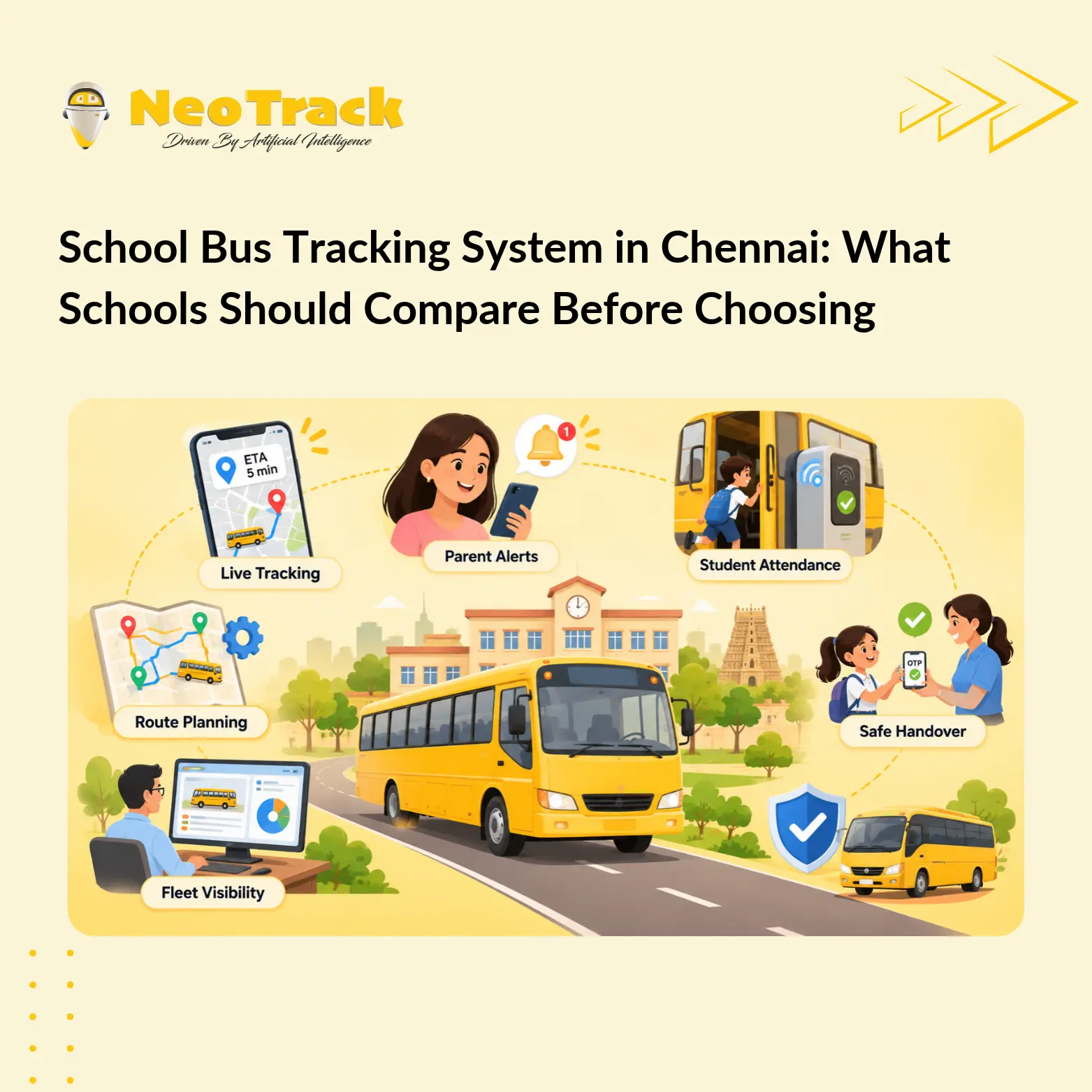
At NeoTrack, parent transport visibility can include live location, ETA, proximity alerts, pickup and drop notifications and delay information depending on the school’s setup. The important part is not simply having a parent app. It is whether that app answers the questions parents actually ask.
GPS alone cannot tell you whether a student boarded
This is where many schools realise that live tracking solves only part of the problem.
Suppose a bus reaches a pickup point at 7:20 AM. GPS can confirm that the vehicle was there, but it cannot tell you whether a particular child actually got inside. If the school wants student-level visibility, you need attendance information connected to the journey.
NeoTrack can support student boarding and deboarding attendance through technologies such as RFID, UHF or face-based identification depending on the requirement. That allows the transport record to include not only where the vehicle travelled, but also whether the student boarded or got down.
For parents, this creates a very different level of confidence. They are no longer looking only at a moving bus on the map. They can receive information connected to their own child’s journey.
If this is an important requirement for your school, our guide to RFID school bus attendance systems goes into this area in more detail.
Think about child handover, especially for younger students
This is another issue that does not appear in a normal GPS demonstration.
Many parents in Chennai are working during school pickup and drop times. A grandparent, relative, house help or another authorised person may sometimes receive the child instead. The caretaker inside the bus may not personally know that person, and calling the parent every single day is not a practical process.
That is why we introduced authorised child handover workflows such as OTP verification. The parent can share the OTP with the authorised person, and the caretaker can verify it before handing over the child.
This is a good example of why we keep telling schools not to evaluate transport technology only from the vehicle point of view. The bus may have reached the correct stop, but the journey is not complete until the child has been safely handed over.
Route planning should be part of your comparison too
Tracking tells you where the bus travelled. Route optimisation asks whether that route should have been planned differently in the first place.
This becomes more important when your school has 10, 20 or more buses. When routes are created manually, each route may look perfectly reasonable on its own. But once you look at the entire fleet together, you may find that two buses are entering almost the same area, one vehicle is travelling unnecessary kilometres or some students are spending too long inside the bus.
From what we have seen, manual route planning becomes increasingly difficult as the fleet grows because one transport manager cannot easily compare every pickup point, vehicle capacity and route combination at the same time.
NeoTrack’s route optimisation can consider student pickup points, vehicle capacity, travel time and the wider fleet before suggesting route options. The aim is not simply to create the shortest route. A route also has to be practical for the students travelling in it.
If this is one of your school’s biggest concerns, our article on school bus route optimisation explains how route planning can affect travel time, vehicle utilisation and operating cost.
Ask what happens when the normal plan breaks
This is one of the most useful things you can do during a product demo.
Most providers will show you the perfect trip. The bus starts, the route appears on the map, the parent tracks it and everything works exactly as expected. Real school transportation does not always behave like that.
A bus can break down. A replacement vehicle may need to be sent. A route may change unexpectedly. A contractor may provide another bus. Parents may already be waiting at their normal stops.
When you are evaluating a school bus tracking system in Chennai, ask the provider to show you what happens in those situations.
At NeoTrack, the school can communicate a vehicle change to affected parents and, where the alternate bus is already part of the tracked fleet, move the relevant trip visibility to that vehicle. This means parents do not continue tracking the original bus while their child is travelling in another one.
These exception cases often reveal far more about the quality of a transport system than the normal journey does.
Outsourced buses need proper visibility too
Many schools use transport contractors, either for the entire fleet or for part of it. That does not mean the school should lose control over the transport operation.
At the same time, the contractor may use the same vehicle for other work outside school hours. The school does not necessarily need access to everything that vehicle does throughout the day. What matters is having the right visibility during the school trip.
So if your school uses outsourced buses, ask how the provider handles contractor vehicles, temporary vehicles and replacement buses. Check whether parents receive the correct trip visibility and whether the school can still see what happened during the journey.
We have covered this particular problem separately in our guide to monitoring outsourced school buses.
Compare the complete cost, not only the GPS device price
Price is obviously going to be part of the decision.
The problem is that two quotations can look very different because they may include completely different things. One price may cover only the GPS device. Another may include installation, SIM connectivity, software access, parent tracking, alerts, attendance and support.
This is why comparing only the headline number can be misleading.
Before choosing a provider, ask for a clear breakdown of what is included in the annual or monthly cost. Understand whether hardware, installation, connectivity, parent access, attendance devices, route management, reports, support, device replacement and optional CCTV are part of the quotation or charged separately.
NeoTrack’s current model provides GPS hardware and installation without a separate hardware purchase cost, while the service pricing depends on the solution required by the school.
We already have a detailed guide on school bus GPS tracker pricing in India, so I would use that if pricing is one of the main areas you are comparing.
The better question is not, “How much is the GPS tracker?” It is, “What will our school actually pay to run the transport system we need?”
Tamil Nadu school bus rules are a separate responsibility
Another point I would be careful about is compliance.
Buying a GPS system does not automatically make a school bus compliant with Tamil Nadu transport rules. Technology can support the school, but regulatory responsibilities go much further than vehicle tracking.
The official Tamil Nadu Government Gazette contains requirements covering areas such as permits, driver qualifications, attendants, vehicle construction, speed governors, fitness inspections, log books and School Level Transport Committees. It also sets requirements around how children are assisted while boarding and deboarding and how younger students are handed over. You can review the official Tamil Nadu school bus rules.
If a provider tells you that installing their GPS system automatically makes your operation “fully compliant”, I would verify that claim separately with the current rules and the relevant RTO.
Technology should help you manage the operation better. It should not be treated as a replacement for the school’s legal and operational responsibilities.
Check how the tracking behaves during an actual moving trip
The phrase “live tracking” can mean different things in practice.
A vehicle location may technically be live but still update slowly enough that the parent experience becomes frustrating. If the app shows the bus several streets away and then suddenly shows it at the stop, parents may quickly stop trusting it.
During the demo, ask to see an actual moving vehicle rather than only a stationary one. Watch how frequently the location changes, how ETA behaves and how the parent app responds during the trip.
NeoTrack was built around frequent location updates, but one of the things we learned over time is that tracking speed alone is not the complete answer. The information also has to remain useful to the school and the parent during a real journey.
Be careful if the system depends completely on the driver’s phone
Some tracking systems use the driver’s smartphone as the main location source. That can be convenient, especially for temporary vehicles, but it also creates dependencies that schools should understand.
The phone needs sufficient battery. Mobile data must remain active. Location permissions need to stay enabled. The correct phone has to remain inside the correct vehicle throughout the trip.
For some temporary situations, this approach may be acceptable. For the school’s primary fleet, we generally prefer dedicated vehicle hardware because the tracking requirement belongs to the vehicle, not to a driver’s personal phone.
If you are comparing both approaches, our guide on school bus GPS devices versus driver tracking apps explains the advantages and limitations of each option.
Do not evaluate only the product. Evaluate the support as well
This is something that often becomes important only after installation.
A GPS device is still hardware. Networks can have problems. A parent may need help with the app. Routes change during the year. A school may add another bus. A driver or caretaker may be replaced. Student pickup points can also change.
A good system therefore needs good post-installation support.
When you compare providers in Chennai, ask who will help you after the system goes live. Find out how a faulty device is identified, what happens if it needs to be replaced, how quickly your team can get support and what happens when your fleet grows.
NeoTrack has a physical presence in Coimbatore, Tamil Nadu, alongside its other offices, and schools can share their city, fleet size and requirements through our enquiry process.
For us, implementation is not complete when the device is fitted. The system has to continue working for your school after the installation team leaves.
What should you actually ask during the demo?
If you are comparing two or three providers, I would avoid letting each company control the entire demonstration.
Instead, take a few situations from your own transport operation and ask every provider to show you how they would handle them.
For example, ask them to demonstrate a moving bus on the school dashboard and then show you exactly what a parent sees at the same time. Ask how the system confirms that a particular student boarded, how delays are communicated and how yesterday’s route can be reviewed.
Then give them an exception. Tell them the regular bus has broken down and another vehicle is taking over. Ask them to show you how the school and parent experience changes.
If you use contractor buses, ask them to show that workflow too.
When you compare providers this way, you are no longer comparing presentations. You are comparing how each system handles your actual transport problems.
What we would understand before recommending anything to your school
If you approached NeoTrack for a school bus tracking solution in Chennai, we would first try to understand how your transport currently works.
We would want to know your fleet size, whether the buses belong to the school or a contractor, how your routes are currently planned and what parents complain about most often. We would also ask whether you need only vehicle location or whether you want student boarding information, ETA alerts, route optimisation, authorised handover, cameras or other transport workflows.
A school with five buses and a school with fifty buses may both search for the same phrase online, but their requirements can be completely different.
That is why we prefer to understand the problem before recommending the solution.
Frequently Asked Questions
Which school bus tracking system is best for schools in Chennai?
There is no single system that is best for every school. Compare the quality of live tracking, parent access, alerts, student attendance, route management, historical data and support. More importantly, ask the provider to demonstrate how the system handles the situations your own transport team deals with every day.
How much does school bus GPS tracking cost in Chennai?
The price depends on whether you need only a GPS device or a wider school transport solution. Hardware, installation, connectivity, parent access, attendance and ongoing support may all affect the total cost. Compare the complete annual operating cost rather than only the device price.
Can parents track the school bus from their phones?
Yes, if the system includes a parent-facing app. Depending on the solution, parents may be able to see live location, ETA, proximity alerts, delays and updates connected to their child’s journey.
Can the system tell us whether a student boarded?
GPS alone cannot identify which student entered the bus. Student-level boarding information requires an attendance method such as RFID, UHF or face-based identification connected with the transport system.
Can school bus tracking work with outsourced buses?
Yes, but the workflow should be checked before purchasing. Ask how contractor buses, temporary vehicles and replacement buses are handled, and what visibility the school and parents receive during those trips.
Is GPS tracking enough for a school bus?
It may be enough if your only requirement is knowing where the vehicle is. If you also want parent alerts, attendance, route planning, authorised handover, reports or other transport workflows, you will need a wider school transport solution.
Does installing GPS make a school bus compliant with Tamil Nadu rules?
No. GPS is only one part of school transport management. Tamil Nadu school bus requirements cover several areas relating to the vehicle, driver, attendant and transport operation. Schools should verify the current requirements with the relevant authorities.
Before you choose a provider, start with your own transport problems
If you are evaluating a school bus tracking system in Chennai, I would not begin by asking which company has the cheapest device or the longest feature list.
Start with what is currently going wrong in your transport operation.
Maybe parents call too often because they cannot see where the bus is. Maybe some children spend too long travelling because routes are not planned well. Maybe you need better attendance visibility. Maybe replacement vehicles create confusion. Maybe your existing GPS system works until something goes wrong and then nobody knows what to do.
Once those problems are clear, the right questions become much easier to ask.
If you would like to see how NeoTrack would work across your own buses and routes, you can request a NeoTrack school transportation demo and share your fleet size, city and current requirements with our team.